Long Cardan Shaft
Rokee® provide Long Cardan Shaft, non-standard coupling customization, drawing design, batch processing, and export the product to your location.
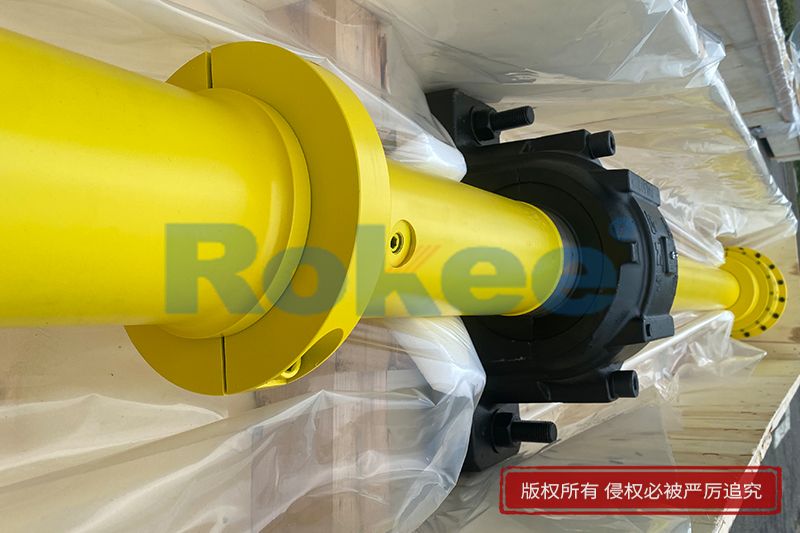
In the realm of mechanical power transmission, the long cardan shaft stands as a critical component that enables the transfer of rotational motion between non-aligned or distant components. Unlike shorter transmission shafts, long cardan shafts are specifically engineered to accommodate greater lengths while maintaining structural integrity, minimizing vibration, and ensuring efficient power transfer. From heavy-duty industrial machinery to large-scale transportation vehicles, these shafts play an indispensable role in numerous sectors, underpinning the operation of systems that rely on precise and reliable torque delivery.
To understand the functionality of long cardan shafts, it is first essential to grasp the basic concept of a cardan shaft assembly. A typical cardan shaft, also known as a universal joint shaft, consists of two universal joints (U-joints) connected by a shaft body. The universal joints are mechanical couplings that allow for the transmission of torque between two shafts that are not in a straight line, accommodating angular misalignment. When extended to longer lengths, the design must address unique challenges such as increased flexure, resonance, and torsional deflection, which can compromise performance and durability. Long cardan shafts thus incorporate specialized features—such as balanced shaft tubes, reinforced end fittings, and sometimes intermediate supports—to mitigate these issues, ensuring that they can operate effectively even when spanning several meters.
The core working principle of a long cardan shaft revolves around the ability of the U-joints to compensate for both angular and axial misalignment between the input and output shafts. Each U-joint comprises two yokes (fork-shaped components) and a cross-shaped spider that connects them. As the input shaft rotates, the spider transfers this motion to the output yoke, allowing for rotation even when the two shafts are at an angle. In long shafts, the addition of intermediate U-joints or supports can further enhance misalignment compensation, reducing the stress on individual components. However, it is important to note that a single U-joint introduces a degree of velocity fluctuation, where the output speed varies slightly as the joint rotates. To counteract this, long cardan shaft assemblies often use paired U-joints arranged in a way that the fluctuations from one joint cancel out the other, resulting in a smooth, constant output speed. This configuration is particularly crucial for long shafts, as velocity fluctuations can be amplified over greater lengths, leading to vibration and premature wear.
The materials used in the construction of long cardan shafts are carefully selected to balance strength, weight, and durability. Given the need to withstand high torque loads and resist fatigue over extended periods, the shaft body is typically made from high-strength steel alloys. These alloys offer excellent torsional rigidity and impact resistance, which are essential for applications involving heavy machinery or high-speed rotation. In some cases, especially where weight reduction is a priority—such as in aerospace or automotive applications—lightweight materials like aluminum alloys or composite materials may be used, though these require additional reinforcement to maintain the necessary structural integrity for long lengths. The U-joint components, including the spider and yokes, are often fabricated from hardened steel to resist wear, with bearings inserted between the spider and yokes to reduce friction and ensure smooth operation.
One of the most prominent applications of long cardan shafts is in the automotive and transportation sector, particularly in commercial vehicles and heavy-duty trucks. In these vehicles, the engine and transmission are typically mounted at the front, while the drive axle is located at the rear, requiring a long shaft to transfer power between them. Long cardan shafts in trucks must accommodate the movement of the rear axle as the vehicle travels over uneven terrain, adjusting to changes in angular alignment and axial displacement. Similarly, in buses and coaches, where the powertrain configuration may involve distant components, these shafts ensure reliable torque delivery to the wheels. Beyond land vehicles, long cardan shafts are also used in marine applications, such as connecting the engine of a ship to its propeller shaft, where they must operate in harsh, corrosive environments while spanning the length of the vessel.
The industrial sector is another major user of long cardan shafts, with applications ranging from manufacturing machinery to power generation equipment. In steel mills, for example, long cardan shafts are used to transmit power from large motors to rolling mills, which require high torque to shape and process steel. These shafts must be capable of withstanding the extreme loads and vibrations associated with heavy industrial operations, often incorporating robust designs with thick-walled shafts and reinforced U-joints. In mining operations, long cardan shafts are employed in equipment such as conveyor systems and crushers, where they transfer power over long distances in challenging, dusty environments. Additionally, in power plants, long cardan shafts can be found in systems that drive pumps, fans, and other auxiliary equipment, ensuring the smooth operation of critical power generation processes.
Agricultural machinery also relies heavily on long cardan shafts to power a variety of implements. Tractors, for instance, use long cardan shafts to connect the engine to rear-mounted equipment such as plows, harvesters, and sprayers. These shafts must be able to accommodate the wide range of angular misalignment that occurs as the tractor moves over uneven farmland, while also transmitting high torque to drive heavy-duty agricultural tools. The design of agricultural cardan shafts often includes features such as quick-disconnect couplings, which allow for easy attachment and detachment of implements, and protective guards to ensure operator safety. Given the exposure to dirt, moisture, and debris in agricultural settings, these shafts are also engineered to be highly resistant to corrosion and wear.
The design of long cardan shafts involves a number of critical considerations to ensure optimal performance and longevity. One of the primary challenges is balancing the shaft’s length with its torsional stiffness. As the length of the shaft increases, its torsional stiffness decreases, which can lead to torsional deflection—where the shaft twists under load—resulting in reduced power transmission efficiency and increased vibration. To address this, engineers may increase the diameter of the shaft or use hollow shaft tubes, which provide greater stiffness per unit weight compared to solid shafts. Another key consideration is dynamic balancing. Long shafts are particularly prone to vibration if they are not properly balanced, as even small imbalances can be amplified over greater lengths, leading to noise, premature wear of bearings and U-joints, and ultimately, component failure. Dynamic balancing involves adjusting the mass distribution of the shaft to ensure that it rotates smoothly at operating speeds, a process that is typically performed during manufacturing using specialized equipment.
Misalignment tolerance is another important design factor for long cardan shafts. The U-joints must be capable of accommodating the maximum expected angular and axial misalignment in the application, without exceeding their design limits. Excessive misalignment can lead to increased stress on the U-joint bearings, causing overheating and premature failure. In some cases, intermediate supports or additional U-joints are used to reduce the amount of misalignment that each individual joint must handle. For example, a very long cardan shaft may be divided into two or more sections connected by intermediate U-joints, each section handling a smaller angle of misalignment, thereby extending the life of the components. Additionally, the choice of bearing type in the U-joints is critical—sealed bearings are often used to prevent contamination and reduce the need for maintenance, especially in harsh environments.
Environmental factors also play a significant role in the design of long cardan shafts. In applications exposed to extreme temperatures, such as in steel mills or aerospace systems, the materials and lubricants used must be able to withstand thermal expansion and contraction, as well as maintain their properties at high or low temperatures. In corrosive environments, such as marine or offshore applications, the shaft and U-joint components may be coated with protective finishes or made from corrosion-resistant materials to prevent rust and degradation. Similarly, in dusty or dirty environments, such as mining or construction sites, protective covers or seals are used to keep debris out of the U-joints and bearings, ensuring smooth operation.
Over the years, the design and technology of long cardan shafts have evolved significantly in response to changing industry demands. One of the key advancements has been the development of more efficient U-joint designs, such as constant-velocity (CV) joints. Unlike traditional U-joints, CV joints maintain a constant output speed regardless of the angle of misalignment, making them ideal for applications where smooth power transmission is critical, such as in high-performance vehicles and precision industrial machinery. While CV joints have been used for many years in shorter shafts, their integration into long cardan shaft assemblies has required innovations in design to accommodate greater lengths and loads.
Another major development in long cardan shaft technology is the use of advanced materials and manufacturing processes. The adoption of high-strength, lightweight alloys and composite materials has allowed for the production of longer, lighter shafts that maintain the necessary structural integrity. For example, carbon fiber composite shafts offer excellent torsional stiffness and strength-to-weight ratios, making them suitable for applications where weight reduction is a priority, such as in aerospace and racing vehicles. Additionally, advanced manufacturing techniques such as computer numerical control (CNC) machining and additive manufacturing have enabled more precise fabrication of shaft components, improving the accuracy of dynamic balancing and reducing production tolerances.
The integration of monitoring and diagnostic technologies has also enhanced the performance and reliability of long cardan shafts. Modern shaft assemblies may be equipped with sensors that measure vibration, temperature, and torque, providing real-time data on the shaft’s condition. This data can be analyzed using predictive maintenance software to identify potential issues—such as bearing wear or shaft misalignment—before they lead to component failure. Predictive maintenance not only extends the life of the shaft but also reduces downtime in critical applications, such as industrial production lines or transportation fleets.
Looking to the future, the evolution of long cardan shafts is likely to be driven by several key trends. The growing focus on sustainability and energy efficiency is expected to lead to the development of lighter, more efficient shaft designs that reduce energy consumption. Additionally, the increasing adoption of electric and hybrid vehicles will require long cardan shafts that are compatible with electric powertrains, which have different torque characteristics and packaging requirements compared to traditional internal combustion engines. In the industrial sector, the trend toward automation and Industry 4.0 is likely to result in more integrated monitoring systems, with long cardan shafts equipped with smart sensors that communicate with centralized control systems to optimize performance and maintenance.
Another potential area of innovation is the use of advanced simulation and modeling tools in the design of long cardan shafts. Finite element analysis (FEA) and computational fluid dynamics (CFD) simulations are already used to predict the performance of shafts under various load conditions, but future advancements in these tools will allow for more accurate modeling of complex scenarios, such as extreme misalignment or dynamic loads. This will enable engineers to design more robust, efficient shafts that are tailored to specific applications, reducing material waste and improving overall performance.
In conclusion, the long cardan shaft is a vital component in mechanical power transmission, enabling the reliable transfer of torque between distant or misaligned components across a wide range of industries. Its design is a careful balance of materials, structural integrity, and dynamic performance, addressing challenges such as vibration, misalignment, and torsional deflection. From heavy-duty trucks and industrial machinery to agricultural implements and marine vessels, long cardan shafts play a crucial role in keeping critical systems operational. As technology advances, these shafts continue to evolve, incorporating new materials, advanced manufacturing processes, and smart monitoring systems to meet the growing demands of efficiency, sustainability, and reliability. The future of long cardan shafts lies in further innovations that enhance their performance, reduce their environmental impact, and integrate them more seamlessly into the next generation of mechanical systems.
« Long Cardan Shaft » Post Date: 2023/12/6
URL: https://www.rokeecoupling.com/en/customer-cases/long-cardan-shaft.html
- Pin Bush Type Flexible Coupling Size Calculation
- Installation of Bushed Pin Flexible Coupling
- Cross Joint Shaft Standard Sizes
- Large Diaphragm Coupling Manufacturer
- Cheapest Flexible Plum Couplings
- Elastic Tyre Coupling Model
- Universal Shaft Coupling
- Flexible Pump Couplings For Sale
- Tire Coupling Adjustment Amount
- Bush Pin Coupling Standard Sizes