NL Nylon Sleeve Gear Couplings
Rokee® provide NL Nylon Sleeve Gear Couplings, non-standard coupling customization, drawing design, batch processing, and export the product to your location.
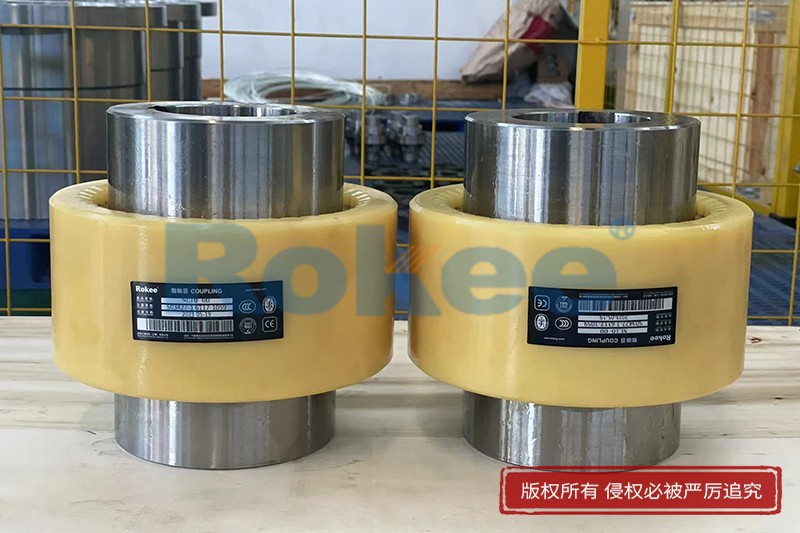
In the field of mechanical transmission, couplings play a crucial role as core components that connect two shafts (driving shaft and driven shaft) in different mechanisms to transmit torque and motion. With the continuous development of industrial technology, the requirements for couplings in terms of transmission efficiency, stability, wear resistance, and installation convenience are increasingly stringent. Among the various types of couplings available, the NL nylon sleeve gear coupling has gained widespread attention and application in many industrial fields due to its unique structural design and excellent comprehensive performance.
Structural Characteristics of NL Nylon Sleeve Gear Coupling
The NL nylon sleeve gear coupling is a type of flexible coupling that mainly consists of three basic parts: two outer gear shafts (or gear hubs), a nylon sleeve with internal teeth, and necessary connecting bolts and washers. Its structural design is scientific and reasonable, and each part cooperates closely to ensure the stability and reliability of the transmission process.
The outer gear shafts are usually made of high-strength alloy steel. After precise forging, heat treatment, and mechanical processing, they have high hardness, strength, and wear resistance. The outer surface of the gear shaft is processed with precise external teeth, and the tooth profile is usually involute. The involute tooth profile has the advantages of stable transmission, large bearing capacity, and easy processing, which can ensure the smooth meshing between the outer gear shaft and the nylon sleeve. The end of the outer gear shaft is designed with a flange structure, which is equipped with evenly distributed bolt holes for connecting with the driving and driven shafts. The flange connection method is simple and reliable, and can effectively transmit torque while ensuring the coaxiality of the two shafts.
The nylon sleeve is the core flexible component of the NL nylon sleeve gear coupling, which is made of high-performance engineering nylon materials (such as PA6, PA66, etc.) through injection molding or compression molding. The inner surface of the nylon sleeve is processed with internal teeth that match the external teeth of the outer gear shaft. The material selection of the nylon sleeve is very critical. High-performance engineering nylon has excellent mechanical properties, such as good toughness, wear resistance, impact resistance, and self-lubrication. At the same time, nylon materials have a certain degree of elasticity, which can play a role in buffering and shock absorption during the transmission process. Compared with metal sleeves, the nylon sleeve has lighter weight, lower noise, and no need for additional lubrication, which greatly reduces the maintenance cost and difficulty.
The connecting bolts and washers are auxiliary components used to fix the outer gear shafts and the nylon sleeve. The bolts are usually made of high-strength carbon steel or alloy steel, which have sufficient tensile strength and shear strength to ensure that the coupling does not loosen during high-speed operation and heavy-load transmission. The washers are used to increase the contact area between the bolt and the flange, prevent the flange from being damaged by the bolt, and enhance the anti-loosening effect of the bolt.
Working Principle of NL Nylon Sleeve Gear Coupling
The working principle of the NL nylon sleeve gear coupling is based on the meshing transmission of gears, and relies on the flexibility of the nylon sleeve to realize the compensation of the relative displacement between the two shafts. Specifically, during the operation of the mechanical equipment, the torque generated by the driving shaft is first transmitted to the outer gear shaft connected to it. Through the meshing between the external teeth of the outer gear shaft and the internal teeth of the nylon sleeve, the torque is transmitted to the nylon sleeve. Then, the nylon sleeve transmits the torque to the other outer gear shaft through the meshing of internal and external teeth, and finally to the driven shaft, thereby realizing the transmission of motion and torque between the driving shaft and the driven shaft.
It should be emphasized that due to the existence of installation errors, thermal expansion and contraction of the shaft during operation, and deformation of the equipment under load, there will inevitably be relative displacements between the driving shaft and the driven shaft, including axial displacement, radial displacement, and angular displacement. The NL nylon sleeve gear coupling can effectively compensate for these relative displacements through the elastic deformation of the nylon sleeve. For axial displacement, the length of the nylon sleeve and the meshing length between the internal and external teeth can be adjusted to adapt to the axial movement of the shaft; for radial displacement and angular displacement, the elasticity and flexibility of the nylon sleeve allow a small amount of deformation during meshing, thereby avoiding the occurrence of excessive stress concentration between the two shafts and ensuring the stable operation of the transmission system.
Performance Advantages of NL Nylon Sleeve Gear Coupling
Compared with other types of couplings (such as rigid gear couplings, elastic pin couplings, etc.), the NL nylon sleeve gear coupling has obvious performance advantages, which make it stand out in many industrial applications.
Firstly, it has excellent buffering and shock absorption performance. The nylon sleeve made of engineering nylon has good elasticity and toughness. When the mechanical equipment is started, stopped, or subjected to load impact, the nylon sleeve can absorb the impact energy through elastic deformation, reduce the impact force on the driving and driven shafts, bearings, and other components, and thus reduce the vibration and noise of the entire transmission system. This is particularly important for equipment that operates under variable load conditions, as it can effectively extend the service life of the equipment and improve the comfort of the working environment.
Secondly, it has good self-lubrication and wear resistance. Engineering nylon materials have inherent self-lubricating properties, which can form a thin lubricating film on the surface during the meshing process of the internal and external teeth, reducing the friction coefficient between the teeth. This not only reduces the wear of the gear teeth but also avoids the need for additional lubrication during use, simplifying the maintenance process and reducing maintenance costs. In addition, the high wear resistance of nylon materials ensures that the coupling can maintain good transmission performance even after long-term operation, improving the reliability and service life of the coupling.
Thirdly, it has strong ability to compensate for relative displacement. As mentioned earlier, the NL nylon sleeve gear coupling can effectively compensate for axial, radial, and angular displacements between the two shafts through the elastic deformation of the nylon sleeve. This feature makes the coupling have strong adaptability to installation errors and equipment deformation, reducing the requirements for installation accuracy and thus facilitating the installation and debugging of the equipment. At the same time, it can also reduce the additional stress generated by the relative displacement on the shaft and bearing, protecting the key components of the equipment.
Fourthly, it has the advantages of light weight and low noise. Compared with metal sleeve gear couplings, the nylon sleeve is much lighter in weight, which reduces the overall weight of the coupling and the inertia during operation. This is beneficial to improving the dynamic performance of the transmission system, especially for high-speed rotating equipment, which can reduce the load on the motor and improve the transmission efficiency. In addition, the meshing between the nylon sleeve and the metal gear shaft is softer than the meshing between metal and metal, which can significantly reduce the noise generated during operation, creating a quieter working environment.
Fifthly, it has simple structure and convenient maintenance. The NL nylon sleeve gear coupling consists of only a few basic parts, with a simple and compact structure. The installation process is relatively simple, and no complex tools or professional skills are required. During use, the nylon sleeve is the only easily worn part. When the nylon sleeve is worn or damaged, it can be replaced quickly without disassembling the entire transmission system, which greatly shortens the maintenance time and reduces the maintenance cost. In addition, the nylon sleeve has a long service life under normal working conditions, which further reduces the frequency of maintenance.
Application Scenarios of NL Nylon Sleeve Gear Coupling
Due to its excellent comprehensive performance, the NL nylon sleeve gear coupling is widely used in various industrial fields that require mechanical transmission. It is especially suitable for occasions that have requirements for buffering, shock absorption, low noise, and convenient maintenance. The main application scenarios are as follows:
In the field of general machinery, the NL nylon sleeve gear coupling is widely used in pumps (such as centrifugal pumps, water pumps, oil pumps), fans (such as centrifugal fans, axial flow fans), compressors, and other equipment. These equipment usually require stable transmission, low noise, and convenient maintenance. The NL nylon sleeve gear coupling can well meet these requirements. For example, in water supply and drainage systems, centrifugal pumps equipped with NL nylon sleeve gear couplings can run stably, reduce vibration and noise, and at the same time, the convenient maintenance feature ensures the continuous operation of the water supply and drainage system.
In the field of agricultural machinery, the NL nylon sleeve gear coupling is also widely used in tractors, harvesters, seeders, and other equipment. Agricultural machinery usually works in harsh environments with large load changes and frequent start-stop. The buffering and shock absorption performance of the NL nylon sleeve gear coupling can effectively protect the transmission system of the agricultural machinery from impact damage. In addition, its wear resistance and self-lubrication performance can adapt to the harsh working environment of agricultural machinery, reducing the frequency of maintenance and improving the work efficiency of the agricultural machinery.
In the field of light industry and textile machinery, such as textile machines, printing machines, packaging machines, etc., the requirements for transmission stability and noise are very high. The NL nylon sleeve gear coupling has the advantages of low noise and stable transmission, which can ensure the quality of textile products, printed products, and packaging products. At the same time, its light weight and small inertia are beneficial to the high-speed operation of light industry and textile machinery, improving production efficiency.
In the field of construction machinery, such as concrete mixers, belt conveyors, elevators, etc., the NL nylon sleeve gear coupling is used to connect the motor and the working mechanism. Construction machinery usually bears large loads during operation, and the NL nylon sleeve gear coupling has high bearing capacity and good wear resistance, which can ensure the stable transmission of torque. In addition, its ability to compensate for relative displacement can adapt to the deformation of construction machinery during operation, protecting the shaft and bearing components.
In addition, the NL nylon sleeve gear coupling is also used in the field of electrical equipment, such as generators, motors, and other equipment, to realize the connection between the motor and the generator or other working mechanisms. Its excellent transmission performance and convenient maintenance features can ensure the stable operation of electrical equipment and reduce maintenance costs.
Installation and Maintenance Points of NL Nylon Sleeve Gear Coupling
The correct installation and scientific maintenance of the NL nylon sleeve gear coupling are crucial to ensuring its performance and service life. The following are the key points of installation and maintenance:
5.1 Installation Points
Firstly, before installation, it is necessary to check the quality of each component of the coupling. Check whether the outer gear shaft has cracks, deformation, or excessive wear; check whether the nylon sleeve has defects such as bubbles, cracks, or uneven tooth thickness; check whether the connecting bolts and washers are complete and free of damage. If any unqualified components are found, they should be replaced in time to avoid affecting the performance of the coupling.
Secondly, the coaxiality of the driving shaft and the driven shaft should be adjusted. Although the NL nylon sleeve gear coupling has the ability to compensate for relative displacement, excessive coaxiality error will increase the wear of the nylon sleeve and the gear shaft, and reduce the service life of the coupling. During installation, a dial indicator or other measuring tools should be used to measure the coaxiality of the two shafts. The radial runout and axial should be controlled within the specified range. Generally, the radial displacement should not exceed 0.2mm, and the angular displacement should not exceed 1°.
Thirdly, the installation sequence should be correct. First, install the two outer gear shafts on the driving shaft and the driven shaft respectively, and fix them with keys or interference fit. Then, apply a small amount of lubricating oil (if necessary) on the external teeth of the outer gear shaft to facilitate the installation of the nylon sleeve. Then, sleeve the nylon sleeve on one of the outer gear shafts, and then move the other outer gear shaft to mesh with the nylon sleeve. Finally, install the connecting bolts and washers, and tighten the bolts evenly with a torque wrench. It should be noted that the tightening torque of the bolts should be in accordance with the specified requirements, not too loose or too tight. Too loose will cause the coupling to loosen during operation, and too tight will cause the flange to deform, affecting the coaxiality.
Fourthly, after installation, a test run should be carried out. Before the official operation of the equipment, a no-load test run and a load test run should be carried out. During the no-load test run, check whether the coupling operates smoothly, whether there is abnormal noise or vibration; during the load test run, check the temperature rise of the coupling and whether the torque transmission is stable. If any abnormal situation is found, the operation should be stopped immediately, and the cause should be found and eliminated.
5.2 Maintenance Points
Firstly, regular inspection should be carried out. During the use of the equipment, the coupling should be inspected regularly (such as daily inspection, weekly inspection, monthly inspection). The inspection contents include: whether the connecting bolts are loose, whether the nylon sleeve is worn or damaged, whether the outer gear shaft has cracks or excessive wear, and whether there is abnormal noise or vibration during operation. If any problems are found, they should be dealt with in time.
Secondly, the nylon sleeve should be replaced in time. The nylon sleeve is the easily worn part of the coupling. With the increase of service time, the nylon sleeve will gradually wear, which will lead to the increase of the gap between the internal and external teeth, affecting the transmission stability. When the wear amount of the nylon sleeve exceeds the specified limit (such as the tooth thickness wear exceeds 10% of the original tooth thickness), the nylon sleeve should be replaced in time. When replacing the nylon sleeve, the model and specification of the original nylon sleeve should be selected to ensure that it matches the outer gear shaft.
Thirdly, the connecting bolts should be checked and tightened regularly. During the operation of the equipment, the connecting bolts may loosen due to vibration. Therefore, the bolts should be checked regularly and tightened if necessary. At the same time, the washers should be checked for damage, and if any damage is found, they should be replaced in time.
Fourthly, the working environment of the coupling should be kept clean. The coupling should be protected from dust, debris, and corrosive media. If the coupling works in a harsh environment (such as a humid, corrosive environment), a protective cover should be installed to prevent the nylon sleeve and the outer gear shaft from being corroded, which will affect the performance and service life of the coupling.
Fifthly, avoid overloading operation. The NL nylon sleeve gear coupling has a certain load-bearing capacity. During the use of the equipment, overloading operation should be avoided, otherwise, the nylon sleeve and the outer gear shaft will be subjected to excessive stress, leading to premature wear or damage. If the load of the equipment changes greatly, a load monitoring device can be installed to ensure that the coupling works within the rated load range.
Conclusion
As an important type of flexible coupling, the NL nylon sleeve gear coupling has won a wide range of applications in many industrial fields due to its unique structural design and excellent comprehensive performance, such as good buffering and shock absorption, self-lubrication and wear resistance, strong ability to compensate for relative displacement, light weight and low noise, simple structure and convenient maintenance. Its working principle is based on the meshing transmission of gears and the elastic deformation of the nylon sleeve, which can effectively transmit torque and motion while compensating for the relative displacement between the two shafts.
In order to give full play to the performance advantages of the NL nylon sleeve gear coupling, correct installation and scientific maintenance are essential. During installation, attention should be paid to checking the quality of components, adjusting the coaxiality of the two shafts, following the correct installation sequence, and carrying out test runs. During use, regular inspection, timely replacement of worn nylon sleeves, regular tightening of connecting bolts, keeping the working environment clean, and avoiding overloading operation are required.
With the continuous progress of industrial technology, the performance requirements for couplings will continue to improve. It is believed that through the continuous optimization of material technology and structural design, the NL nylon sleeve gear coupling will have better performance and broader application prospects in the future, making greater contributions to the development of the industrial field.
« NL Nylon Sleeve Gear Couplings » Post Date: 2023/10/11
URL: https://www.rokeecoupling.com/en/customer-cases/nl-nylon-sleeve-gear-couplings.html
- Laminated Coupling Efficiency
- Pin Type Coupling Parts
- GIICL2 Gear Coupling
- Size Chart of Brake Drum Gear Couplings
- Exploded View of Bush Type Couplings
- Diaphragm Connecting Rod Couplings
- Ball Joint Drum Couplings Parameters
- Structural Schematic Diagram Of Drum Gear Coupling
- Gear Coupling Alignment
- Pin Bush Type Flexible Couplings Supplier