ML Flexible Claw Coupling
Rokee® provide ML Flexible Claw Coupling, non-standard coupling customization, drawing design, batch processing, and export the product to your location.
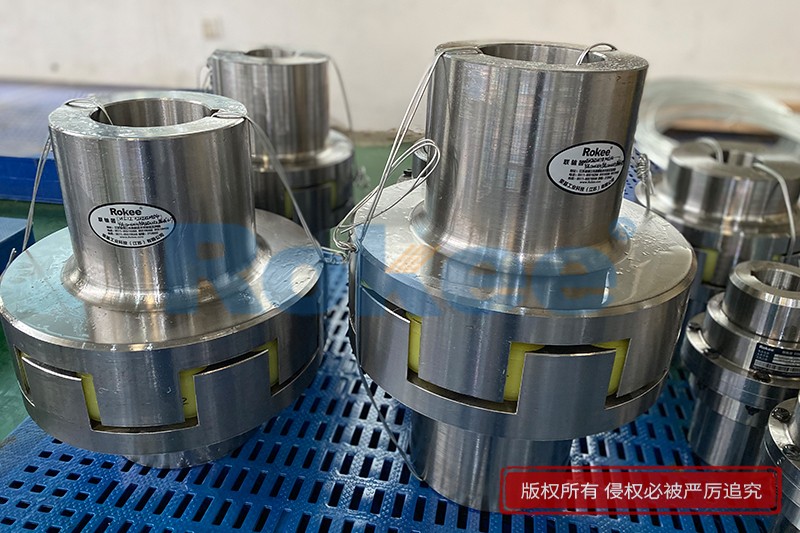
In the realm of power transmission systems, couplings serve as critical components that bridge rotating shafts, enabling the seamless transfer of torque while accommodating various forms of misalignment. Among the diverse range of couplings available, the ML Flexible Claw Coupling stands out for its unique combination of simplicity, reliability, and cost-effectiveness. Designed to meet the demands of both light-duty and medium-duty industrial applications, this type of coupling has become a staple in sectors ranging from manufacturing and automation to agriculture and logistics.
To understand the functionality of ML Flexible Claw Couplings, it is first essential to examine their structural composition. Unlike complex coupling designs that incorporate multiple moving parts, the ML Flexible Claw Coupling features a straightforward three-piece structure: two metal claw-shaped hubs and a flexible elastomeric element positioned between them. The hubs, typically fabricated from high-strength materials such as carbon steel, alloy steel, or aluminum alloy, are designed with a series of evenly spaced claws (or teeth) along their circumferential edges. These claws are precision-machined to ensure a tight and secure fit with the flexible element, which is often made from durable rubber, polyurethane, or other elastomeric compounds. The flexible element, also known as a spider or star washer, is engineered with corresponding notches or grooves that mesh perfectly with the claws of the two hubs, creating a secure connection that allows for torque transmission while absorbing vibrations and compensating for misalignment.
The choice of materials for each component of the ML Flexible Claw Coupling is critical to its performance and longevity. The metal hubs are selected based on the application’s torque requirements and operating environment. Carbon steel hubs are widely used for general-purpose applications due to their excellent strength-to-weight ratio and affordability, while alloy steel hubs are preferred for high-torque or high-speed applications where enhanced durability is necessary. Aluminum alloy hubs, on the other hand, are ideal for lightweight applications or environments where corrosion resistance is a priority. The flexible elastomeric element is chosen based on factors such as temperature resistance, chemical compatibility, and vibration absorption capacity. Polyurethane, for instance, offers superior wear resistance and load-bearing capacity compared to rubber, making it suitable for heavy-duty applications, while rubber is more effective at damping vibrations and is often used in applications where noise reduction is critical.
The working principle of ML Flexible Claw Couplings revolves around the interaction between the metal hubs and the flexible element. When torque is applied to one of the shafts, the corresponding hub rotates, and the claws of the hub exert a force on the flexible element. This force is then transmitted through the flexible element to the claws of the second hub, which in turn drives the second shaft. The flexibility of the elastomeric element plays a key role in accommodating three main types of misalignment that commonly occur in rotating shafts: angular misalignment (where the shafts are not collinear but intersect at an angle), parallel misalignment (where the shafts are parallel but offset from each other), and axial misalignment (where the shafts move along their axial direction). By deforming slightly under load, the flexible element compensates for these misalignments, reducing stress on the shafts, bearings, and other components of the power transmission system.
In addition to accommodating misalignment, ML Flexible Claw Couplings also provide effective vibration damping and noise reduction. Rotating machinery often generates vibrations due to imbalances, uneven load distribution, or external factors, which can lead to increased wear and tear on components, reduced operational efficiency, and excessive noise. The elastomeric element of the ML Flexible Claw Coupling acts as a buffer, absorbing and dissipating these vibrations before they are transmitted to other parts of the system. This not only extends the lifespan of the machinery but also improves the working environment by reducing noise levels. Furthermore, the flexible element serves as a shock absorber, mitigating the impact of sudden load changes or start-stop operations, which can cause significant stress on rigid couplings.
One of the most notable advantages of ML Flexible Claw Couplings is their simplicity in design and ease of installation. Unlike complex couplings that require specialized tools or technical expertise for assembly, ML Flexible Claw Couplings can be installed quickly and easily. The three-piece design allows for straightforward mounting: the two hubs are first attached to the respective shafts using set screws, keyways, or compression fittings, and the flexible element is then simply snapped into place between the hubs. This simplicity not only reduces installation time and labor costs but also makes maintenance and replacement straightforward. In the event of wear or damage to the flexible element, it can be replaced without removing the hubs from the shafts, minimizing downtime and operational disruption.
Another key advantage of ML Flexible Claw Couplings is their cost-effectiveness. Compared to other types of flexible couplings, such as gear couplings or disc couplings, ML Flexible Claw Couplings are typically more affordable to manufacture and purchase. This cost advantage makes them an attractive option for small and medium-sized enterprises (SMEs) or applications with budget constraints. Despite their lower cost, ML Flexible Claw Couplings do not compromise on performance or reliability, making them suitable for a wide range of industrial applications. Additionally, their low maintenance requirements and long service life contribute to lower total cost of ownership over time.
ML Flexible Claw Couplings are versatile components that find applications in a diverse range of industries. In the manufacturing sector, they are commonly used in conveyor systems, packaging machinery, printing presses, and textile machinery, where they facilitate the transfer of torque between motors and driven components while accommodating misalignment and reducing vibration. In the automation and robotics industry, ML Flexible Claw Couplings are used in servo motor systems, where precise torque transmission and backlash-free operation are essential. The flexibility of the coupling ensures that the servo motor’s motion is accurately transmitted to the load, while the compact design makes it suitable for the tight spaces often found in robotic systems.
In the agricultural industry, ML Flexible Claw Couplings are employed in farm machinery such as tractors, harvesters, and irrigation systems. These applications often involve harsh operating conditions, including high levels of vibration, dust, and temperature fluctuations, and the robust design of ML Flexible Claw Couplings ensures reliable performance under such conditions. The flexible element’s ability to absorb shocks and vibrations is particularly beneficial in agricultural machinery, which often operates with uneven loads and frequent start-stop cycles. In the logistics and material handling sector, ML Flexible Claw Couplings are used in forklifts, conveyors, and automated guided vehicles (AGVs), where they enable smooth and efficient power transmission, contributing to the overall productivity of the material handling process.
Despite their numerous advantages, ML Flexible Claw Couplings are not suitable for all applications. They are generally recommended for light-duty to medium-duty applications with moderate torque requirements and operating speeds. High-torque or high-speed applications, such as those found in large industrial pumps, turbines, or heavy-duty gearboxes, may require more robust coupling designs, such as gear couplings or disc couplings, which can handle higher loads and speeds without compromising performance. Additionally, ML Flexible Claw Couplings are not ideal for applications with extreme temperature conditions or exposure to harsh chemicals, as these can degrade the elastomeric element over time. In such cases, specialized couplings with heat-resistant or chemical-resistant materials may be more appropriate.
Proper maintenance is essential to ensure the optimal performance and longevity of ML Flexible Claw Couplings. Regular inspection is the cornerstone of effective maintenance, and operators should periodically check the coupling for signs of wear, damage, or misalignment. Key areas to inspect include the flexible element, which may show signs of cracking, tearing, or hardening due to age, temperature, or chemical exposure; the claws of the hubs, which may become worn or damaged if the coupling is subjected to excessive loads or misalignment; and the fasteners (such as set screws or bolts) that secure the hubs to the shafts, which should be checked for tightness to prevent slippage.
Lubrication is another important maintenance consideration for ML Flexible Claw Couplings, although the requirements vary depending on the type of flexible element. Couplings with rubber or polyurethane elements typically do not require lubrication, as these materials are self-lubricating and lubrication can cause degradation. However, if the coupling is used in dusty or dirty environments, it may be necessary to clean the coupling periodically to prevent the buildup of debris, which can cause premature wear. For couplings with metal hubs that are prone to corrosion, particularly those used in outdoor or humid environments, regular inspection for rust and the application of anti-corrosion treatments (such as paint or rust inhibitors) can help extend their service life.
When replacing the flexible element of an ML Flexible Claw Coupling, it is important to select a replacement that is compatible with the original coupling. The replacement element should have the same dimensions, material composition, and load-bearing capacity as the original to ensure optimal performance. Using an incompatible element can lead to reduced torque transmission, increased vibration, and premature failure of the coupling. Additionally, during replacement, it is advisable to check the alignment of the shafts to ensure that any misalignment is within the coupling’s rated capacity, as excessive misalignment can cause premature wear of the new flexible element.
The future development of ML Flexible Claw Couplings is likely to focus on improving their performance and expanding their application range through material innovation and design optimization. Advances in elastomeric materials, such as the development of high-temperature-resistant and chemical-resistant polyurethanes, are expected to enable ML Flexible Claw Couplings to be used in more demanding environments. Additionally, the integration of sensor technology into coupling designs may become more common, allowing for real-time monitoring of coupling performance, including temperature, vibration, and wear. This predictive maintenance capability can help operators identify potential issues before they lead to failure, minimizing downtime and improving the overall reliability of power transmission systems.
In conclusion, ML Flexible Claw Couplings are essential components in modern industrial power transmission systems, offering a unique combination of simplicity, reliability, cost-effectiveness, and versatility. Their three-piece design, featuring two metal hubs and a flexible elastomeric element, enables them to accommodate misalignment, dampen vibrations, and transmit torque efficiently. Suitable for a wide range of applications across manufacturing, automation, agriculture, and logistics, ML Flexible Claw Couplings play a critical role in ensuring the smooth and efficient operation of rotating machinery. With proper maintenance and the ongoing development of new materials and designs, ML Flexible Claw Couplings are poised to remain a key component in industrial power transmission for years to come. Whether in small-scale manufacturing operations or large-scale industrial facilities, the ML Flexible Claw Coupling continues to prove its value as a reliable and cost-effective solution for power transmission needs.
« ML Flexible Claw Coupling » Post Date: 2023/10/8
URL: https://www.rokeecoupling.com/en/customer-cases/ml-flexible-claw-coupling.html
- Which Is The Cheapest Manufacturer For Transmission Seat Diaphragm Couplings
- Coal power system dregs transmission
- Material of Bushed Pin Type Flexible Coupling
- Flexible Coupling Diaphragm
- Cross Joint Universal Joint Shaft
- Coaxiality Of Elastic Pin Tooth Coupling
- Integrated Plum Couplings
- Plum Coupling With Transition Section
- Torque of Bushed Pin Type Coupling
- Common Drum Couplings