LLA Rubber Tire Coupling
Rokee® provide LLA Rubber Tire Coupling, non-standard coupling customization, drawing design, batch processing, and export the product to your location.
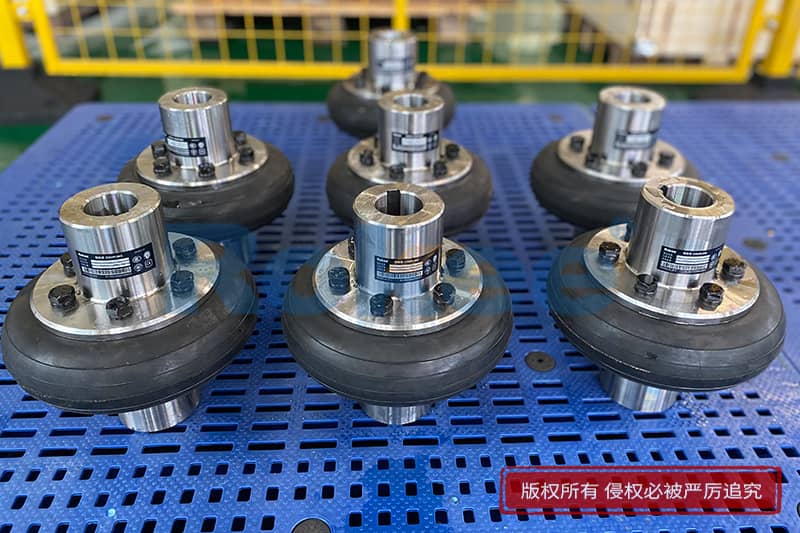
In the field of mechanical transmission, couplings play a pivotal role as critical components that connect two shafts (driving shaft and driven shaft) in different mechanisms to transmit torque and motion. Among the diverse types of couplings available, the LLA rubber tire coupling has gained widespread recognition and application due to its unique structural design and excellent performance characteristics. This type of coupling integrates flexibility, shock absorption, and compensation capabilities, making it suitable for a variety of industrial scenarios where stable and efficient power transmission is required.
The structural design of LLA rubber tire coupling is relatively compact and scientific, consisting of several core components that work together to ensure reliable power transmission. The main parts include two metal flanges, a rubber tire element, connecting bolts, and nuts. The metal flanges are usually made of high-strength alloy steel or cast iron, which possess excellent mechanical strength and wear resistance to withstand the torque and load during operation. Each flange is designed with a series of bolt holes that correspond to the connecting bolts, facilitating the assembly with the driving and driven shafts. The rubber tire element, which is the core flexible component of the coupling, is mounted between the two metal flanges. It is typically made of high-quality synthetic rubber materials, such as nitrile rubber, neoprene, or EPDM, which are selected based on the specific working environment and performance requirements. These rubber materials are characterized by good elasticity, oil resistance, high-temperature resistance, and aging resistance, enabling the tire element to effectively absorb shocks and vibrations while compensating for axial, radial, and angular deviations between the two shafts. The connecting bolts and nuts are used to fasten the metal flanges and the rubber tire element, ensuring that the entire coupling assembly is tightly connected and can transmit torque stably.
The working principle of LLA rubber tire coupling is based on the flexible deformation of the rubber tire element to achieve power transmission and deviation compensation. When the driving shaft rotates, the torque is first transmitted to the connected metal flange. Through the frictional force and the mechanical connection between the flange and the rubber tire element, the torque is then transferred to the rubber tire element. Due to the elasticity of the rubber material, the rubber tire element deforms slightly during the torque transmission process, which not only ensures the smooth transmission of power but also absorbs the shocks and vibrations generated by the driving shaft or the driven equipment. At the same time, if there are axial, radial, or angular deviations between the driving shaft and the driven shaft caused by installation errors, thermal expansion and contraction, or other factors, the rubber tire element can compensate for these deviations through its own deformation. This flexible compensation capability effectively reduces the additional stress on the shafts, bearings, and other components, thereby protecting the entire transmission system and extending its service life.
LLA rubber tire coupling offers a range of key advantages that make it stand out among other types of couplings. One of the most prominent advantages is its excellent shock absorption and vibration damping performance. The rubber tire element, as a flexible medium, can effectively absorb the impact loads and vibrations generated during the operation of mechanical equipment. This is particularly beneficial for equipment that operates with intermittent loads or high-speed rotation, such as pumps, fans, and motors. By reducing vibrations, the coupling not only improves the stability and reliability of the equipment operation but also reduces noise pollution in the workplace. Another significant advantage is its strong deviation compensation capability. As mentioned earlier, the LLA rubber tire coupling can compensate for axial, radial, and angular deviations between the two shafts. This feature greatly simplifies the installation process of the transmission system, as it does not require extremely high precision alignment between the driving and driven shafts. It also accommodates the slight deviations that may occur during the operation of the equipment due to thermal expansion and contraction or structural deformation, avoiding excessive stress on the shafts and bearings.
In addition to shock absorption and deviation compensation, LLA rubber tire coupling also exhibits good adaptability to harsh working environments. The high-quality rubber materials used in the tire element have excellent resistance to oil, water, dust, and various chemical substances, as well as good high-temperature and low-temperature resistance. This enables the coupling to operate stably in a variety of harsh industrial environments, such as chemical plants, mining sites, and metallurgical facilities, where the equipment may be exposed to corrosive media or extreme temperature conditions. Furthermore, the LLA rubber tire coupling has a simple structure, easy installation, and convenient maintenance. The assembly and disassembly process is straightforward, requiring only basic tools and skills. In the event of damage to the rubber tire element, it can be easily replaced without disassembling the entire transmission system or moving the connected equipment, which significantly reduces maintenance time and costs. Another advantage is its long service life. The metal flanges are made of high-strength materials that are resistant to wear and fatigue, while the rubber tire element is made of high-quality materials with good aging resistance. With proper maintenance, the LLA rubber tire coupling can maintain stable performance for a long time, reducing the frequency of component replacement and improving the overall operational efficiency of the equipment.
Due to its excellent performance characteristics, LLA rubber tire coupling is widely used in various industrial fields. One of the most common applications is in the power transmission system of pumps and fans. Pumps and fans are essential equipment in many industries, such as water treatment, chemical industry, and power generation. During operation, they often generate vibrations and may have slight deviations between the motor shaft and the pump/fan shaft. The LLA rubber tire coupling can effectively absorb these vibrations and compensate for the deviations, ensuring the stable operation of the pumps and fans and extending their service life. Another important application field is the metallurgical industry. In metallurgical equipment, such as rolling mills, blast furnaces, and converters, the power transmission system is subject to large impact loads and vibrations. The LLA rubber tire coupling's excellent shock absorption performance and high torque transmission capacity make it suitable for these harsh working conditions, ensuring the reliable operation of the metallurgical equipment.
The mining industry is another major application area for LLA rubber tire coupling. Mining equipment, such as conveyors, crushers, and excavators, operates in harsh environments with large amounts of dust, vibration, and impact loads. The LLA rubber tire coupling's robust structure, good dust resistance, and excellent shock absorption capability enable it to adapt to these harsh conditions, ensuring the continuous and stable operation of the mining equipment. In addition, LLA rubber tire coupling is also widely used in the agricultural machinery industry. Agricultural equipment, such as tractors, harvesters, and irrigation pumps, often operates in uneven terrain and is subject to variable loads and vibrations. The coupling's flexibility and deviation compensation capability can effectively protect the equipment's transmission system, improving its reliability and operational efficiency. Other application fields include the chemical industry, paper industry, and construction machinery industry, where the coupling's resistance to corrosive media, stable performance, and easy maintenance make it an ideal choice for power transmission.
Proper maintenance is essential to ensure the stable performance and long service life of LLA rubber tire coupling. The following are some key maintenance considerations. First, regular inspection is crucial. It is recommended to inspect the coupling regularly during the operation of the equipment. The inspection items include the condition of the rubber tire element, the tightness of the connecting bolts and nuts, and the wear condition of the metal flanges. During the inspection, special attention should be paid to whether the rubber tire element has cracks, bulges, or signs of aging. If any damage or deterioration is found, the rubber tire element should be replaced in a timely manner to avoid failure of the coupling during operation. Second, the connecting bolts and nuts should be checked regularly for tightness. Due to the vibration during equipment operation, the bolts and nuts may become loose, which can affect the stability of the coupling's power transmission and even lead to component damage. If loose bolts or nuts are found, they should be tightened immediately. It is also recommended to use lock washers or thread lockers to prevent the bolts from loosening again.
Third, proper lubrication is important for the metal components of the coupling. Although the rubber tire element does not require lubrication, the metal flanges and connecting bolts should be properly lubricated to prevent rust and corrosion. It is recommended to use appropriate lubricants based on the working environment and temperature conditions. However, it should be noted that the lubricant should not come into contact with the rubber tire element, as some lubricants may damage the rubber material and affect its performance. Fourth, the coupling should be operated within its rated torque and speed range. Overloading or overspeed operation can cause excessive stress on the rubber tire element and metal components, leading to premature failure of the coupling. It is important to ensure that the equipment's operating parameters are within the coupling's rated range. Fifth, when replacing the rubber tire element, it is necessary to select the correct type and specification of the element that matches the coupling. The replacement process should be carried out in accordance with the manufacturer's instructions to ensure that the new element is properly installed and fastened. In addition, after replacement, the coupling should be tested to ensure that it operates normally without abnormal noise or vibration.
In conclusion, LLA rubber tire coupling is an important mechanical component with excellent performance characteristics, including good shock absorption, strong deviation compensation capability, adaptability to harsh environments, simple structure, and easy maintenance. Its unique structural design and working principle make it suitable for a wide range of industrial applications, such as pumps and fans, metallurgical equipment, mining equipment, and agricultural machinery. Proper maintenance of the LLA rubber tire coupling is essential to ensure its stable performance and long service life, which includes regular inspection, tightening of connecting bolts, proper lubrication, and operation within rated parameters. With the continuous development of industrial technology, the performance requirements for mechanical transmission components are constantly increasing. The LLA rubber tire coupling, with its inherent advantages, will continue to play an important role in various industrial fields, contributing to the stable and efficient operation of mechanical equipment. In the future, with the advancement of material technology and structural design, it is expected that the LLA rubber tire coupling will be further optimized to meet the more stringent requirements of modern industrial production, such as higher torque transmission capacity, better high-temperature resistance, and longer service life.
« LLA Rubber Tire Coupling » Post Date: 2023/8/19
URL: https://www.rokeecoupling.com/en/customer-cases/lla-rubber-tire-coupling.html
- Elastic Sleeve Gear Coupling
- Integrated Claw Couplings
- High Speed Membrane Couplings
- Cross Joint Shaft Brands
- Compressor Tyre Couplings
- Rigid Diaphragm Coupling Price
- Pin Bolt Coupling Price
- Flange Gear Coupling For Sale
- Cross Shaft Universal Coupling Manufacturer
- Machine Drawing of Brake Drum Geared Couplings