GIICL Gear Couplings
Rokee® provide GIICL Gear Couplings, non-standard coupling customization, drawing design, batch processing, and export the product to your location.
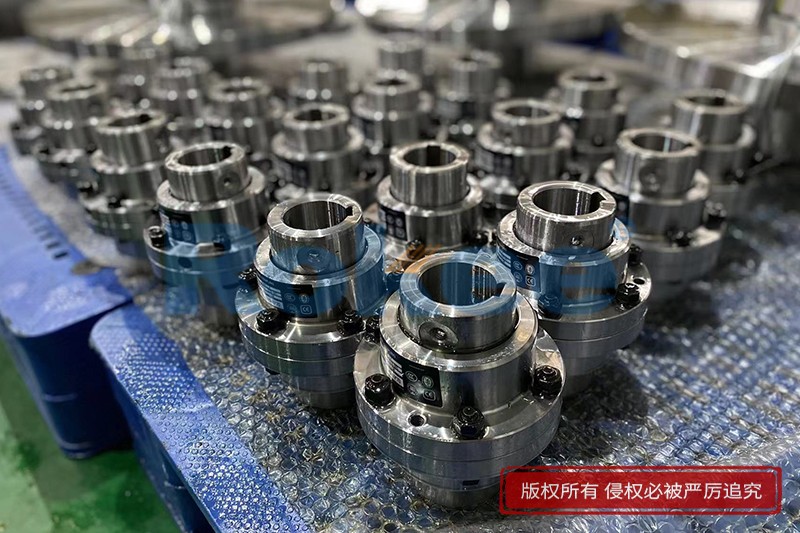
In the field of mechanical transmission, couplings play a pivotal role as key components that connect two shafts (driving shaft and driven shaft) to transmit torque and rotational motion. Among the various types of couplings available, gear couplings are widely recognized for their high torque-carrying capacity, excellent adaptability to misalignment, and robust performance in harsh operating conditions. The GIICL gear coupling, as a typical representative of rigid-flexible gear couplings, has become an indispensable part in many heavy-duty mechanical systems.
The structural design of the GIICL gear coupling is the foundation of its excellent performance, featuring a compact and rational structure that combines rigidity and flexibility. Generally, a standard GIICL gear coupling consists of four main components: external gear sleeves, internal gear rings, flanges, and connecting bolts. The external gear sleeves are directly connected to the driving and driven shafts through interference fit or keyway connection, ensuring a tight and reliable connection that minimizes relative sliding between the shaft and the coupling. The external teeth of the sleeves are usually designed with involute tooth profiles, which are widely used in gear transmission due to their smooth meshing, high load-bearing capacity, and good wear resistance.
The internal gear rings, which mesh with the external gear sleeves, are mounted on the flanges. The flanges are connected to each other by high-strength bolts, forming a closed transmission system. One of the notable structural features of the GIICL gear coupling is the presence of a certain amount of backlash between the external gear sleeves and internal gear rings. This backlash is not a design defect but a necessary arrangement to compensate for manufacturing errors, thermal expansion caused by temperature rise during operation, and slight misalignment between the two shafts. In addition, some GIICL gear couplings are equipped with sealing devices, such as oil seals or O-rings, to prevent the leakage of lubricating oil and the ingress of external impurities (such as dust, moisture, and debris), thereby protecting the gear meshing surface and extending the service life of the coupling.
The working principle of the GIICL gear coupling is based on the meshing transmission of gears, which converts the rotational motion and torque of the driving shaft into that of the driven shaft through the engagement between the external gear sleeves and internal gear rings. When the driving shaft rotates, it drives the external gear sleeve connected to it to rotate. The rotating external gear sleeve then drives the internal gear ring meshing with it to rotate, and the internal gear ring drives the flange to rotate through a rigid connection. Finally, the flange transmits the torque to the driven shaft through the connecting bolts, completing the torque and motion transmission process.
It should be emphasized that the GIICL gear coupling has a certain degree of flexibility, which is mainly reflected in its ability to compensate for three types of misalignment between the driving and driven shafts: axial misalignment, radial misalignment, and angular misalignment. Axial misalignment refers to the relative displacement of the two shafts along the axial direction, which can be compensated by the axial movement of the external gear sleeve in the internal gear ring. Radial misalignment is the horizontal offset between the axes of the two shafts, and this can be adjusted through the radial clearance between the gear teeth. Angular misalignment is the angle formed between the two shafts, which is compensated by the tilting of the external gear sleeve relative to the internal gear ring. This multi-directional misalignment compensation capability makes the GIICL gear coupling particularly suitable for mechanical systems where it is difficult to achieve perfect coaxiality between the driving and driven shafts, reducing the additional stress on the shafts, bearings, and other components, and improving the overall operational stability of the system.
Compared with other types of couplings (such as elastic couplings, rigid couplings, and chain couplings), the GIICL gear coupling has a series of prominent performance advantages. Firstly, it has an excellent high torque-carrying capacity. Due to the involute gear meshing design, the contact area between the teeth is large, which allows the coupling to transmit large torques without excessive deformation. This advantage makes the GIICL gear coupling particularly suitable for heavy-duty transmission scenarios, such as in metallurgical machinery, mining equipment, and large-scale fans, where large torque transmission is required.
Secondly, the GIICL gear coupling exhibits strong adaptability to harsh operating environments. It can operate stably in high-temperature, high-humidity, dusty, and vibrating environments, which is attributed to its robust structural design and the protection provided by the sealing devices. The gear teeth are made of high-strength alloy steel, which has good wear resistance, corrosion resistance, and impact resistance, ensuring long-term reliable operation even under severe working conditions.
Thirdly, the GIICL gear coupling has a compact structure and a small footprint, which is beneficial for reducing the overall size of the mechanical system and optimizing the layout of the equipment. Despite its high torque-carrying capacity, the coupling does not require a large installation space, making it suitable for use in confined spaces where other types of couplings may not be applicable.
Fourthly, the GIICL gear coupling offers high transmission efficiency. The meshing of the involute gears is smooth, with minimal friction and energy loss during transmission. This high efficiency is crucial for reducing energy consumption and improving the economic performance of the mechanical system, especially in large-scale industrial equipment that operates continuously for a long time.
The excellent performance of the GIICL gear coupling enables it to be widely applied in various industrial fields. One of the main application areas is the metallurgical industry. In metallurgical equipment such as rolling mills, converters, and blast furnaces, the GIICL gear coupling is used to connect the motor and the working mechanism, transmitting large torques to drive the rolling of steel plates, the rotation of converters, and the operation of blast furnace blowers. The harsh operating environment in the metallurgical industry, with high temperature, large vibration, and heavy load, requires the coupling to have strong durability and reliability, which the GIICL gear coupling can fully meet.
Another important application field is the mining industry. Mining equipment such as coal crushers, belt conveyors, and mine hoists need to transmit large torques in dusty, humid, and vibrating environments. The GIICL gear coupling, with its high torque-carrying capacity, good sealing performance, and strong adaptability to misalignment, is an ideal choice for these equipment. It ensures the stable operation of the mining equipment, reduces the frequency of failures, and improves the efficiency of mining operations.
The power generation industry also widely uses GIICL gear couplings. In thermal power plants, hydropower plants, and wind power plants, the coupling is used to connect the turbine (or water turbine, wind turbine) and the generator, transmitting the rotational motion and torque of the turbine to the generator to generate electricity. The high transmission efficiency and reliable performance of the GIICL gear coupling are crucial for ensuring the stable power output of the power plants. In addition, in large-scale fans and pumps used in power plants, the GIICL gear coupling is also used to connect the motor and the impeller, ensuring the efficient operation of the ventilation and water supply systems.
Other application fields include the chemical industry, construction machinery, and marine engineering. In the chemical industry, the GIICL gear coupling is used in chemical reactors, compressors, and pumps, where it operates in corrosive environments and needs to transmit large torques. In construction machinery such as excavators, bulldozers, and cranes, the coupling is used to connect the engine and the hydraulic pump, ensuring the reliable transmission of power. In marine engineering, the GIICL gear coupling is used in ship propulsion systems, connecting the main engine and the propeller, withstanding the complex loads and vibrations during ship navigation.
The correct installation of the GIICL gear coupling is crucial for ensuring its performance and service life. There are several key considerations during the installation process. Firstly, it is necessary to check the coaxiality of the driving and driven shafts. Although the GIICL gear coupling can compensate for a certain amount of misalignment, excessive misalignment will increase the wear of the gear teeth, generate additional noise and vibration, and reduce the service life of the coupling. Therefore, during installation, a dial indicator or other precision measuring tools should be used to adjust the coaxiality of the two shafts to within the allowable range specified by the design.
Secondly, the connection between the coupling and the shafts should be firm. If a keyway connection is used, the key should be properly fitted into the keyway, and the coupling should be pressed onto the shaft tightly to prevent relative sliding between the coupling and the shaft during operation. If an interference fit is used, heating or cooling methods can be used to assemble the coupling onto the shaft, ensuring a tight fit.
Thirdly, the installation of the flanges and connecting bolts should be correct. The flanges should be aligned properly, and the connecting bolts should be tightened evenly with the specified torque. Uneven tightening of the bolts will cause uneven stress on the flanges, leading to deformation and affecting the meshing of the gears.
Fourthly, appropriate lubricating oil should be added before operation. The gear meshing surface of the GIICL gear coupling needs to be lubricated to reduce friction and wear, dissipate heat, and prevent corrosion. The type and grade of the lubricating oil should be selected according to the operating conditions (such as temperature, load, and speed) of the coupling. The oil level should be maintained within the specified range, and the lubricating oil should be replaced regularly.
Regular maintenance is essential to extend the service life of the GIICL gear coupling and ensure its stable operation. The maintenance work mainly includes the following aspects: Firstly, regular inspection of the coupling. It is necessary to check the wear of the gear teeth, the tightness of the connecting bolts, the integrity of the sealing devices, and the level and quality of the lubricating oil. If any wear, looseness, leakage, or deterioration of the lubricating oil is found, timely measures should be taken to repair or replace the relevant components.
Secondly, regular replacement of the lubricating oil. The lubricating oil will gradually deteriorate due to oxidation, contamination, and heat during operation, losing its lubricating effect. The replacement cycle of the lubricating oil should be determined according to the operating conditions and the manufacturer's recommendations. Before replacing the lubricating oil, the internal cavity of the coupling should be cleaned to remove impurities and wear debris.
Thirdly, timely repair of worn components. If the gear teeth are severely worn, pitted, or cracked, they should be replaced in time to avoid further damage to the coupling and other components. The connecting bolts that are loose or damaged should also be tightened or replaced promptly. The sealing devices that are leaking should be repaired or replaced to prevent the leakage of lubricating oil and the ingress of external impurities.
Fourthly, attention to the operating conditions of the coupling. During the operation of the mechanical system, it is necessary to monitor the temperature, vibration, and noise of the coupling. If abnormal temperature rise, excessive vibration, or abnormal noise occurs, the operation should be stopped immediately to check the cause and take corresponding measures to eliminate the fault. This can prevent minor faults from developing into major failures, ensuring the safe and reliable operation of the entire mechanical system.
In conclusion, the GIICL gear coupling is a high-performance mechanical transmission component with a rational structural design, excellent torque-carrying capacity, strong adaptability to misalignment, and good durability. Its unique structural and performance advantages make it widely applicable in various heavy-duty industrial fields, such as metallurgy, mining, power generation, and chemical industry. To give full play to the performance of the GIICL gear coupling, it is essential to pay attention to the correct installation and regular maintenance, ensuring that the coupling operates in good condition. With the continuous development of industrial technology, the design and manufacturing technology of the GIICL gear coupling will also be continuously improved, making it more efficient, reliable, and environmentally friendly, and better meeting the growing needs of modern industrial production.
« GIICL Gear Couplings » Post Date: 2023/9/26
URL: https://www.rokeecoupling.com/en/customer-cases/giicl-gear-couplings.html
- Tire Coupling Brand
- Transmission Seat Diaphragm Coupling Agent
- Drum Ball Joint Couplings
- Diaphragm Flexible Coupling Manufacturer
- Flexible Pin Bush Couplings Factory
- Metallic Disc Couplings Wholesale
- Gap Chart of Brake Drum Gear Couplings
- Bush Pin Type Flexible Coupling Drawing
- GICLZ Drum Gear Coupling
- Standard Price Of Drum Gear Coupling